Religion turns off readers, and yet …

That’s an advice given to authors, though it’s something I cannot avoid in my own novels and even poetry. Where else can we fully address the deepest values we hold?

Politics doesn’t seem to be working that way, for sure.

Is science fiction the best we can do for now when it comes to grappling with philosophical issues?

Still, I’ve dug in, ranging from the spirituality of yoga and Buddhism in Zen and Tibetan traditions to Quaker and Mennonite Christianity to Greek Orthodoxy as well as Indigenous strands.

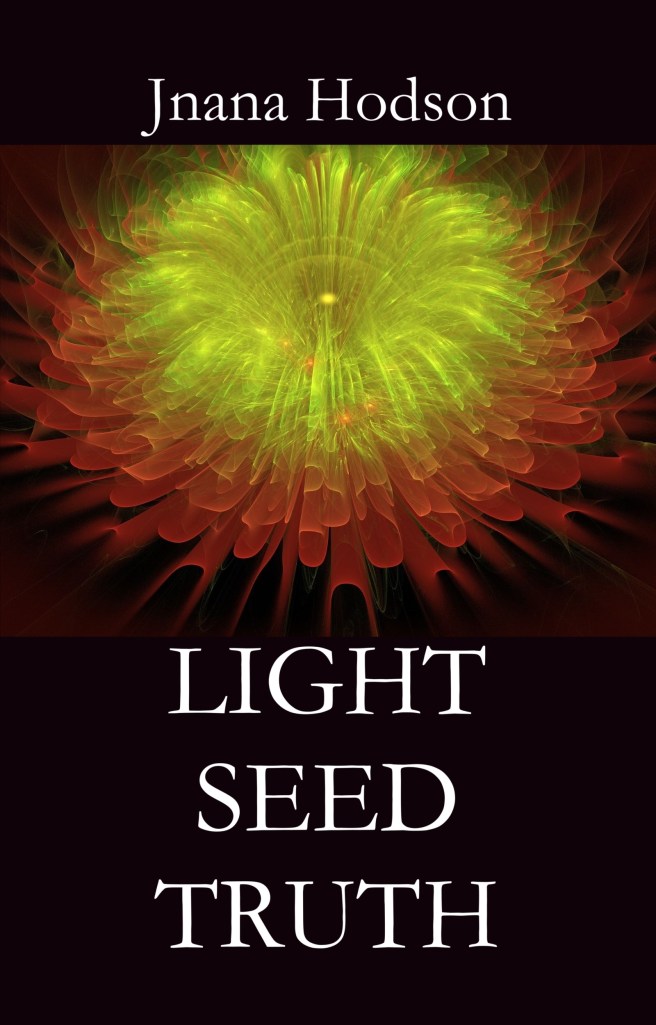
I tackle this most directly in Light Seed Truth, an ebook that includes four earlier booklets investigating the revolutionary impact early Quakers found in applying the metaphors of Light, Seed, and Truth. To that I add examples of the power of metaphor in modern secular society, just for balance.

My goal is to raise readers’ awareness and sensitivity rather than convert anyway to a particular faith.

With religion, I want to hear how faith is experienced by different individuals, rather than what they speculate they should be experiencing.

The best mystics I’ve known have surprisingly practical and humorous.

~*~

You can find it and more in the digital platform of your choice at Smashwords, the Apple Store, Barnes & Noble’s Nook, Scribd, Sony’s Kobo, and other fine ebook retailers. You can also ask your public library to obtain it.

Sounding so dated now

RETAIL THERAPY: used books or classical/jazz/folk CDs.

WHAT IS YOUR FAVORITE HOTEL? To date, Omni, Providence, Rhode Island. Yes, over Boston, Chicago, and New York.

I’LL KNOW I HAVE IT MADE WHEN: I can rent a cottage by the sea or a mountain lake. Or I have grandchildren.

WHAT IS YOUR CURRENT PROJECT? Creating an author’s website and blog.

WHO WOULD YOU MOST LIKE TO INVITE TO DINNER? My agent or publisher. If only I had one.

UPCOMING: Retirement.

That ‘X’ in Xmas isn’t what most folks think

Considering that X is also the Roman numeral for ten, here goes this week’s Tendrils.

  1. X, or Chi, is the first letter in Greek for Christ. Thus, using it as shorthand for the Yule holiday has nothing to do with striking Christ out of holiday celebrations.
  2. Applied to the English word Christmas, the use dates from the 1500s. Elsewhere, the use of ‘X’ for Christ goes back to at least the fourth century.
  3. It did take me a while in doing genealogy research of the 1600s to realize that Xpher was the name Christopher.
  4. Only half of Americans attend religious services on Christmas Eve or Day.
  5. The holiday was widely ignored in Colonial America. For that matter, the first session of the U.S. Congress was held on December 25, 1789. It wasn’t until 1870 that Christmas was proclaimed a federal holiday.
  6. Turkey is edging out ham as the centerpiece of the Christmas dinner in America. It’s even a big day for cranberry, perhaps surpassing Thanksgiving. Swan and peacock were earlier favorites, though I’m not sure where.
  7. The Rockefeller Center tree started out small. The first one, in 1931, was undecorated. Two years later, one appeared with lights. Each year afterward saw a bigger tree, culminating in the familiar giant that boasts more than 50,000 LED lights.
  8. Christmas caroling was originally mostly drunken men going door to door and making a nuisance of themselves. And then the unemployed poor took over with their begging bowls.
  9. The oldest Santa parade in the U.S. is in Peoria, Illinois, dating from 1888. Apparently, it’s played well there.
  10. The original Christmas pudding was a soup made of raisins and wine.

Notes from a Yule tree search in the woods

The tree the kid wants ain’t natchural! At least not the ones we’ve cut from the wild.

What we find in the woods are typically lopsided, with the growth mostly to one side. And they tend to be more open than full, which can have its own appeal when it comes to adding ornaments.

Not that she perceives that on her arrival from the metropolis.

She’s always been challenging and demanding.


Regarding our real estate market

We were staggered and bewildered by the number of people – mainly from California, Texas, and New York – who were buying up properties out here, sight unseen during the height of the Covid epidemic. Well, that went for our Dover in New Hampshire, too. Their bids definitely inflated the selling prices.

It seemed pretty risky, from the locals’ point of view, and that included us. There are so many things, including warning signs, that you discover in a walkthrough of a property, fine distinctions that don’t appear in photos or descriptions. Just think of smells or the neighbors or even lighting as well.

There are also so many things you won’t catch if you see a property only in fine weather. Not just leaks or drafts, either. As a quip around here goes, will those buyers be selling once they’ve endured a winter living here?

We were lucky to purchase when we did. The prices not only went up dramatically soon after that, they’ve stayed up, We remain mystified about how young families are paying what they are for housing.

Avoiding the G-word while examining faith

One of the things I’ve learned over the years is that turning any discussion of religion away from the doctrinaire formulas and instead to direct feelings and experiences can be quite refreshing, even inspiring.

Essentially, that boils down to shifting from “head” speculation and instead to personal encounters, “heart,” if you will. It moves the focus from the abstract to something more concrete.

In my book, Light Seed Truth, I try to take that a step further by avoiding the G-word altogether except in direct quotation. Part of that stems from a Jewish tradition that considers the name of the Holy One to be too sacred to be uttered, leading instead to substitutes that include the all-cap LORD in English translations, meaning The Name. And part stems from just how different our individual perceptions of the word can be, often defaulting into an old bearded male of some sort, despite other options. Even Adonai and Elohim carry different connotations, not that I go into them. Just be aware.

Besides, the G-word can too easily create a wall between those who “believe” and those who don’t.

Add to that the surveys that find atheists, overall, are more familiar with the Bible than are members of varying denominations, and I do want to include them in the discussion.

In my ebook, I do hope to encourage an appreciation for wonder itself in our lives.

Not a bad place to start, is it?

You can find the volume in the digital platform of your choice at Smashwords, the Apple Store, Barnes & Noble’s Nook, Scribd, Sony’s Kobo, and other fine ebook retailers. You can also ask your public library to obtain it.

Could this be how it ends?

The time to go has come. It should have arrived several years earlier, rather than continuing in so much wheelchair loitering, trapped in a dream-state. Now the phone call, “I don’t expect him to live another week,” leads into packing and flight.

Unable to awaken, fully, from the bewildering disconnections. This is not the heart attack or car crash I had predicted. Nor the old age of graceful evaporation into a vanishing point of history. No one will say now, “He lost his mind,” but the new names change nothing. This terminal illness, in stages, until the patient no longer remembers how to eat or breathe. Perhaps, mercifully, an angel will break through the sterile chambers of medical enterprise, and another nature will take its course.

This flesh, shrinking to bone, rather than feather.